Some brands you recognise from a single sentence: the voice of a familiar presenter, an expert you follow, an advert you have heard for years. A voice carries trust and personality that writing struggles to convey. Today, with voice cloning, every article on your website can be read in your own voice without you recording each one. This article is about brand voices, and how to bring yours to your website.
Your voice is part of your brand
We usually think of a brand as a logo, colours and fonts. But for content people listen to, the voice is what they remember. A familiar voice feels like talking to a real person rather than reading an anonymous web page.
For experts, doctors, lawyers, teachers and anyone building a personal brand, the voice matters even more. Clients trust you because they know you. When they hear your articles in your own voice, the distance between writer and reader almost disappears.
For a business, one consistent brand voice across every article gives the content its own identity, different from the hundreds of websites that share the same few popular voices.
What voice cloning is
Voice cloning creates an AI voice that learns from a real person’s voice. You record a sample of your voice following the service’s instructions, and you receive an AI voice that can read any text with a timbre and intonation close to yours.
Vbee AIVoice offers voice cloning. How to create a voice and which plans include it are explained on the Vbee site.
When your whole website speaks in your voice
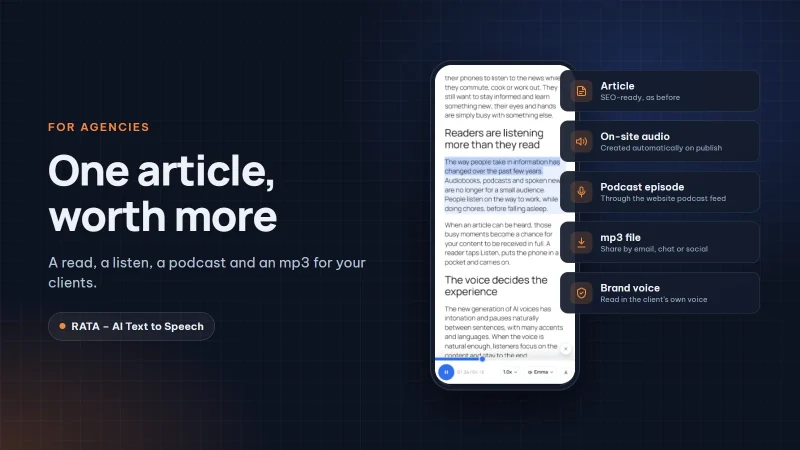
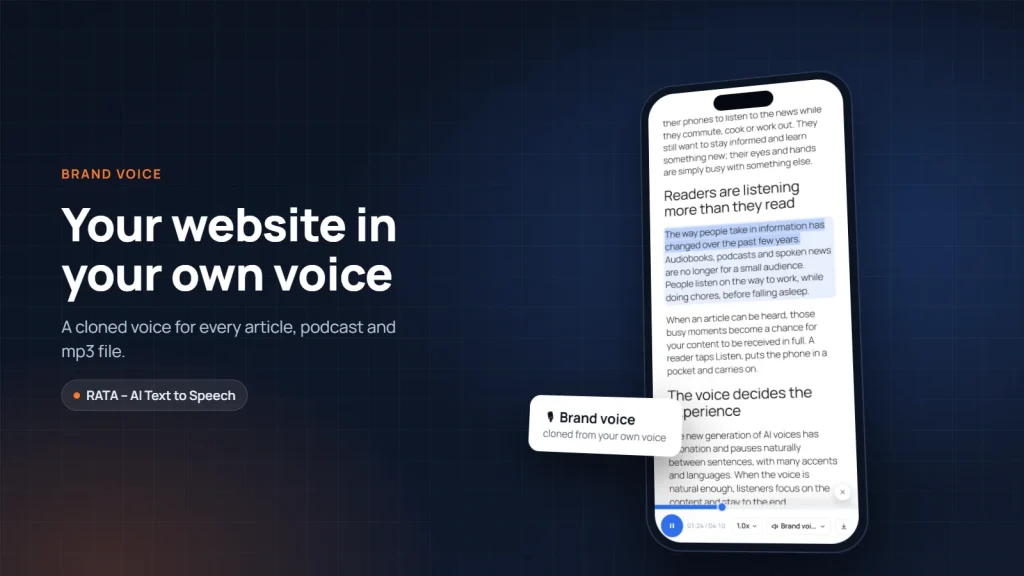
Once you have a cloned voice, the next question is where to use it. With the paid version of RATA, from the Blogger plan, you choose your cloned voice as your website’s reading voice. From then on, each new article is read in your voice as soon as it is published, with no extra steps.
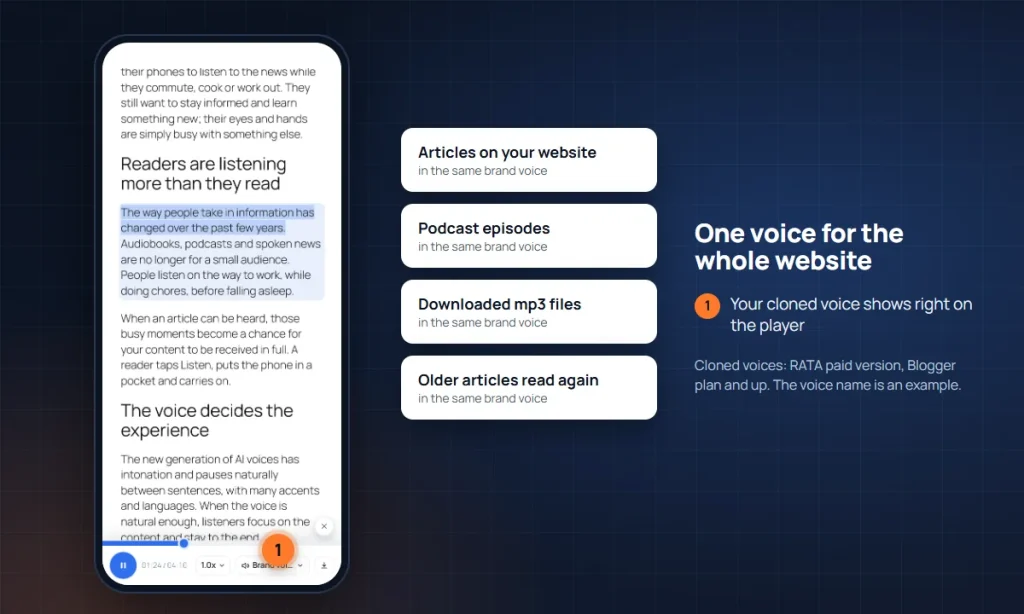
That voice follows your content everywhere. Readers hear it on your website, followers hear it in their podcast app through your website’s podcast feed, and busy people download the mp3 to listen later. Everywhere it is your voice, consistent and recognisable.
Older articles can be read again in your brand voice too, so your whole archive shares one voice. And when you edit an article, only the edited paragraphs are read again, so the brand voice always matches the latest content.
If your business wants more than one voice, the Business plan can rotate several voices between articles, so regular listeners do not get bored. We covered turning articles into podcasts in One article, one more channel.
Which voice should be your brand voice
For a personal brand the answer is usually clear: your own. Your followers already know your voice from videos, talks or calls, so hearing your articles in that voice feels natural.
For a business, the choice deserves more thought. The founder’s voice feels close and sincere, which suits small businesses and brands built around one person. The voice of an in house expert builds trust for specialist content. A professional presenter’s voice brings polish, but needs a clear agreement on long term use.
Whoever you choose, think about the listener first. A warm, clear voice at a moderate pace suits most content. A very fast or very deep voice may work in a short advert but becomes tiring over a ten minute article.
Prepare a good voice recording
The quality of a cloned voice depends a lot on the original recording. You do not need a professional studio, but a few basics make a big difference.
Record somewhere quiet with little echo, such as a small room with curtains and soft furnishings. Read in your natural voice, the way you talk to clients, rather than trying to sound like a broadcaster. Keep a steady distance from the microphone and avoid recording when you are tired or your voice is hoarse.
The exact length and content of the recording are set by the voice service; just follow their instructions. A good recording today will read hundreds of articles for you later.
Use voices responsibly
A voice is part of a person’s identity. Only clone your own voice, or the voice of someone who has clearly agreed, ideally in writing. If your business uses the voice of an employee or a presenter, agree on how the voice may be used after that person stops working with you.
Be transparent with listeners. A short line on your website saying that articles are read by an AI voice based on the author’s voice keeps their trust, rather than leaving them to find out on their own.
Finally, keep the account that holds your voice secure. A cloned voice is an asset and deserves the same protection as a password.
Conclusion
Voice cloning makes possible something that used to be reserved for big brands: all your content in a voice of its own. When your website reads articles in your own voice, listeners do not just receive information; they feel the person behind it. See the Blogger plan and the other RATA plans on the product page. In the next article we answer the question everyone asks: how much does adding a voice to your website cost.
Frequently asked questions
Question 1. Can the free version use a cloned voice?
No. Cloned voices are a feature of the paid version of RATA, from the Blogger plan. The free version uses the browser voice and the ready made Vbee AI voices.
Question 2. Where do I create my cloned voice?
You create it in your own Vbee account, following Vbee’s instructions. Then you choose that voice in the RATA settings.
Question 3. Can one website use several cloned voices?
Yes, from the Business plan. The voices rotate between articles.
Question 4. May I clone someone else’s voice?
Only if that person clearly agrees. A voice is part of someone’s identity, so get a written agreement before cloning and using it.
Links to Vbee in this article carry RATA’s referral code; RATA may earn a commission at no extra cost to you. “Vbee” and “Vbee AIVoice” are trademarks of Vbee AITalk. RATA is independent software developed by Fox40.